The Workers and Factories That Powered America Through World War II
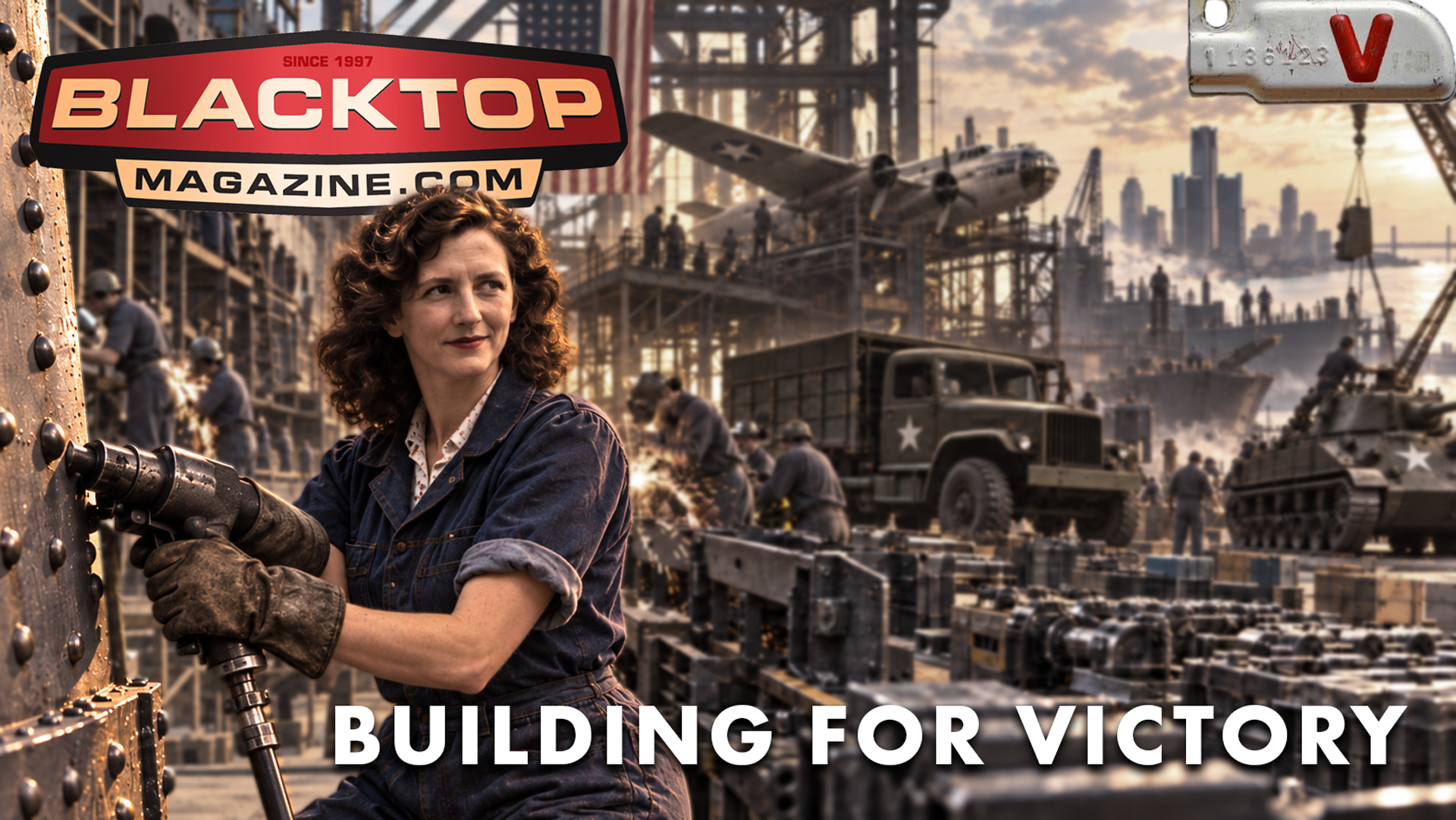
My grandmother Helen met her future husband Bert during World War II, not at a dance hall, restaurant or neighborhood gathering, but at the Kaiser shipbuilding docks on San Francisco Bay. Helen was small in stature, which turned out to be a valuable asset in wartime production. Her size allowed her to crawl into tight sections of the ships where larger workers couldn’t easily reach. Bert was her supervisor. Somewhere between long shifts, steel hulls and the urgency of wartime production, they met, fell in love and eventually started a family.
Their story was hardly unique.
Across America, people who had never imagined themselves building ships, aircraft, tanks or military vehicles suddenly found themselves doing exactly that. Factories changed almost overnight. Workers learned new trades. Women stepped into industrial jobs traditionally held by men who had left for military service. Entire industries were redirected toward a single purpose.
In late 1941, automobile plants were still stamping fenders, machining engines and sending new Fords, Chevrolets, Plymouths and Dodges toward dealerships across America. The auto industry was built around annual model changes, sales competition and the constant promise of something newer, faster or more stylish.
Then came December 7, 1941.
After the attack on Pearl Harbor, America’s automobile industry suddenly had a very different customer. The government didn’t need chrome trim or a new family sedan. It needed bombers, tanks, military trucks, aircraft engines, Jeeps, weapons and parts—and it needed them in quantities the world had never seen.
Within months, Detroit had effectively been drafted.
Asked First. Ordered Later.
The transition actually began before Pearl Harbor. President Franklin D. Roosevelt could see that the war in Europe was moving closer to America’s doorstep, and in late 1940 he called upon the United States to become the “Arsenal of Democracy.”
Automakers began accepting military contracts. Plants were expanded. Engineers studied military equipment and tried to determine how Detroit’s mass-production methods could be applied to machines that had never been intended for an automobile assembly line.
At first, the government was asking industry to participate.
After Pearl Harbor, it was no longer much of a request.
By early 1942, civilian automobile production had essentially stopped. Steel, aluminum, rubber and manufacturing capacity were redirected toward military needs. The same companies that had spent decades fighting one another for American car buyers were suddenly working toward the same goal.
Ford Takes to the Air
Ford’s most famous wartime achievement didn’t have four wheels. It had four engines.
At the enormous Willow Run plant outside Detroit, Ford took on production of the B-24 Liberator bomber. Aircraft manufacturing had traditionally depended heavily on skilled craftsmen and relatively slow production methods. Ford looked at the process through the eyes of an automobile manufacturer.
The challenge was enormous. An airplane was far more complicated than a passenger car, but Ford engineers began breaking the bomber into assemblies and subassemblies, standardizing procedures and creating a moving production system.
Eventually, Willow Run became one of the great symbols of America’s wartime industrial might, producing thousands of B-24s and, at peak production, completing roughly one bomber every hour.
Ford also manufactured military trucks, armored vehicles, generators, engines and begrudgingly hundreds of thousands of military Jeeps (along with Willys). The company that had helped perfect mass-produced automobiles was now applying those same principles to the machinery of war.
Chevrolet Trades Cars for Combat Equipment
Chevrolet’s wartime effort was part of the enormous General Motors production network. GM facilities across the country were converted to military work, turning out everything from trucks and aircraft components to guns, ammunition and armored vehicles.
At Chevrolet’s Tonawanda operation in New York, workers who had built automobile engines and axles found themselves involved in producing massive radial aircraft engines.
Think about that transformation for a moment.
A machinist could go from making components destined for a Chevrolet passenger car to building parts for an engine that might soon be flying over Europe or the Pacific. The tools and manufacturing knowledge were familiar. The purpose had completely changed.
Chevrolet and GMC also became major producers of military trucks. These weren’t machines designed to impress people in a dealership showroom. They were expected to carry men, equipment and supplies across mud, sand, snow and bomb-damaged roads.
Reliability suddenly meant something much more serious than getting to work Monday morning.
Chrysler Goes Into the Tank Business
Chrysler may have faced the most unlikely assignment of them all.
Before the United States officially entered the war, Chrysler was selected to operate the Detroit Tank Arsenal, a massive facility dedicated to producing armored vehicles.
There was one obvious problem.
Chrysler built cars, not tanks.
But the government wasn’t really hiring Chrysler because it knew tanks. It was hiring Chrysler because it knew production.
Automobile manufacturers understood how to stamp steel, machine parts, organize suppliers and assemble complicated machines repeatedly and quickly. Those skills translated remarkably well to military manufacturing.
The Detroit Tank Arsenal eventually produced more than 22,000 tanks, including large numbers of M4 Shermans. Meanwhile, Dodge factories turned out military trucks, ambulances, command cars and weapons carriers.
The styling department had taken a back seat.
Function was everything.
America’s Real Weapon Was the Assembly Line
Ford didn’t invent the bomber. Chevrolet didn’t invent the aircraft engine. Chrysler didn’t invent the tank.
What America brought to the war was the ability to manufacture complicated machines in enormous quantities.
For decades, the automobile industry had been perfecting stamping, casting, forging, machining, welding, interchangeable parts and assembly-line production. It had also created a massive network of suppliers capable of feeding parts into factories by the thousands.
When America entered the war, those skills became a strategic advantage.
The enemy wasn’t merely competing against American soldiers overseas. It was competing against Detroit’s ability to build another truck, another engine, another tank and another airplane—again and again and again.
Rosie Was Real
The machines couldn’t build themselves.
As millions of American men entered military service, factories faced a massive labor shortage just as production demands were exploding. Women answered the call in numbers that permanently changed the American workforce.
The image of “Rosie the Riveter” became famous, but Rosie wasn’t just a poster.
She was my grandmother Helen. Working in the Kaiser shipyards in San Francisco Bay. She was the woman crawling into a tight section of a ship because she was the person who could get the job done. She was the woman operating a drill press at an automobile plant in Detroit, riveting an airplane wing or welding an armored vehicle. She was the one filling shells for DuPont in Indiana.
Millions of ordinary Americans suddenly found themselves connected directly to a global war through the work they performed every day.
They weren’t on the battlefield, but what they built was.
Then It All Changed Again
When the war ended in 1945, America’s factories faced another enormous challenge.
They had to go back.
Tank plants and bomber factories no longer needed to operate at wartime levels. Automobile factories had to restore tooling, develop civilian products and restart production after several years in which ordinary Americans had been unable to walk into a dealership and buy a new car.
The demand was tremendous.
Returning servicemen wanted cars. Families were growing. Suburbs were expanding. Americans who had spent the war years repairing aging prewar automobiles were ready for something new.
America responded.
Within just a few years, the industrial machine that had built bombers, tanks and military trucks was once again producing Fords, Chevrolets and Chryslers—and laying the groundwork for the great automobile boom of the 1950s and 1960s.
Perhaps that’s what makes this chapter of American automotive history so remarkable.
Detroit didn’t just build some military equipment on the side.
For several years, it essentially stopped being the automobile industry as Americans knew it.
Factories changed. Workers changed. Priorities changed.
For a brief but critical period, Ford, General Motors and Chrysler weren’t trying to outsell one another.
They were trying to outbuild the enemy.
And back in a Kaiser shipyard on San Francisco Bay, a young woman named Helen crawled into places other workers couldn’t reach, while her supervisor Bert apparently began noticing more than just the quality of her work.
The war changed industries.
It changed America.
And in our family, it changed everything.